


Next Design V5.0 Released
~ Bringing digital transformation and AI utilization in embedded software development closer to hand ~
DENSO CREATE INC. (Headquarters: Nagoya, Aichi Prefecture; President and Representative Director: Hideaki Miyagawa) will begin offering the latest version of its system and software design tool, "Next Design V5," on May 29, 2026. At the same time, the company will also begin offering a free evaluation version to let users experience the new features.
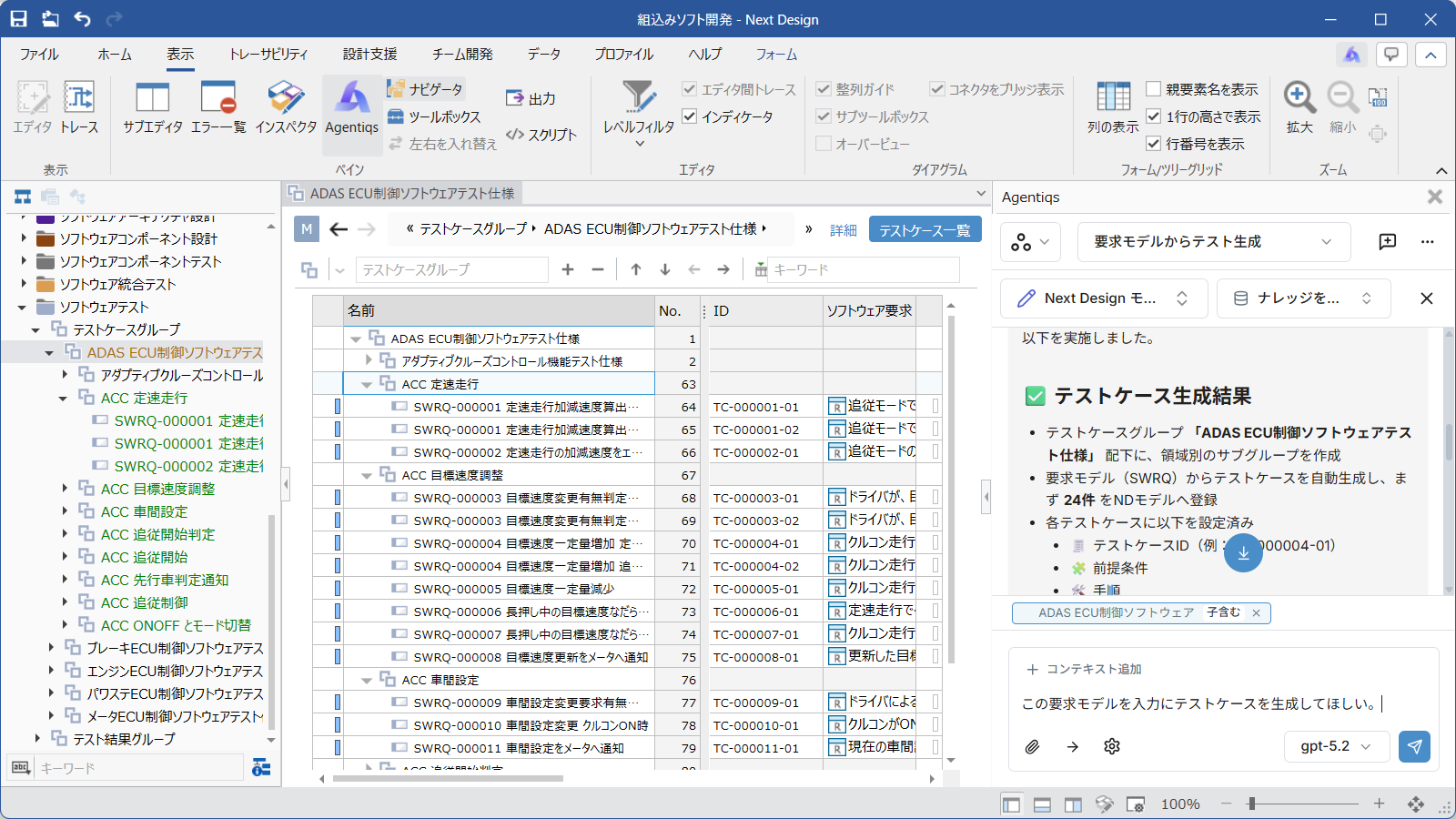
Next Design V5 Screen Image
Key Highlights of the Next Design V5 Major Version Up
1. Quick start with a package tailored for embedded software development
Drawing on Automotive-SPICE[1], a development process cultivated in the automotive industry, as a reference and incorporating our own expertise, we now offer a new package designed for embedded software development. By providing a base package that systematizes V-model processes and deliverables, we significantly compress the setup time and costs required when adopting Next Design, allowing you to experience the benefits of implementation in the design field even sooner.
The base package includes a set of metamodels (structural definitions) and view definitions (representation methods). You can use them as-is to start designing immediately, or tailor them to your company's processes and target domain for organizational use.
As standard design methods, we offer a lineup of packages that let you immediately use approaches such as UML/SysML, timing charts, flowcharts, DFD, FMEA, FTA, and USDM. This allows you to combine the optimal methods for each specific task—from requirement analysis to detailed design and failure analysis—enabling centralized management of design information in a single tool.
Furthermore, extensions are included to automate routine tasks in the field. You can immediately utilize features such as batch model generation from upstream processes, sequential renumbering of IDs, automatic extraction of impact ranges, and automatic aggregation of test results. In addition to C#, Next Design now supports Python, which is widely used in development environments, empowering a broader range of engineers to drive field improvements leveraging design data.
2. AI-Assisted Design for Efficient, High-Quality Embedded Software Development
Seamless AI integration with our proprietary AI agent platform "DC Agentiqs"[2]—designed to support engineers across all development stages—provides powerful assistance for tasks that previously relied on experienced personnel, such as performing design based on field expertise, conducting design reviews aligned with specific viewpoints, and defining profiles tailored to specific domains.
Integrated directly into the Next Design UI, the DC Agentiqs chat window is seamlessly embedded, allowing you to leverage AI without the hassle of switching tools during your routine design work. Models currently being edited by the user are automatically recognized as context, ensuring even more accurate AI design assistance.
For example, AI can read existing design documents and requirement specifications to automatically generate models such as use cases, scenarios, and test cases, accelerating the workflow from design review to test design. Additionally, it can cross-check design data in Next Design against review viewpoints and mandatory items to uncover omissions and inconsistencies, minimizing oversights in design reviews and supporting higher quality.
Moreover, AI assists with reviewing design items within metamodels and reflecting them in view definitions, lowering the barrier for defining profiles that previously depended on experienced staff, and making it easier to efficiently define domain-specific profiles.
3. Incorporating feedback from the field to improve usability
Based on extensive feedback gathered from sites where Next Design has been implemented, we have enhanced both usability and practicality.
We have enhanced features related to frequent operations and external tool integration, including bookmarks for frequently used display states, improved operability for sequence diagrams, enhanced document export, import of customer requirements in ReqIF format, and Submodule support in NDGit. By reflecting feedback from the field, we have refined the usability down to the finest details, further boosting daily operational efficiency and comfort.
For details on the V5 major version upgrade, please refer to here.
Benefits of Implementing Next Design
Adopting Next Design can be expected to standardize design information, improve efficiency by reducing manual work, and enhance design accuracy. It can be flexibly applied right on-site regardless of project scale or industry. Furthermore, in V5, the embedded software development package and AI design assistance enable high productivity right from the early stages of implementation.
Pricing and Operating Environment
Price (Annual Subscription):
- User License: From 69,600 JPY (76,560 JPY including tax)
- Floating License: From 278,400 JPY (306,240 JPY including tax)
Operating Environment:
- Windows 11
[1] Automotive-SPICE is a registered trademark of the Verband der Automobilindustrie e.V. (VDA). The provided package references Automotive-SPICE, but does not imply compliance with it. ↩
[2] DC Agentiqs is an AI agent platform created to enable full-scale AI utilization in development environments. "Field-specialized agents" seamlessly integrate with the development tools used on-site, creating deliverables just like a field engineer based on field-specific knowledge and past deliverables. ↩